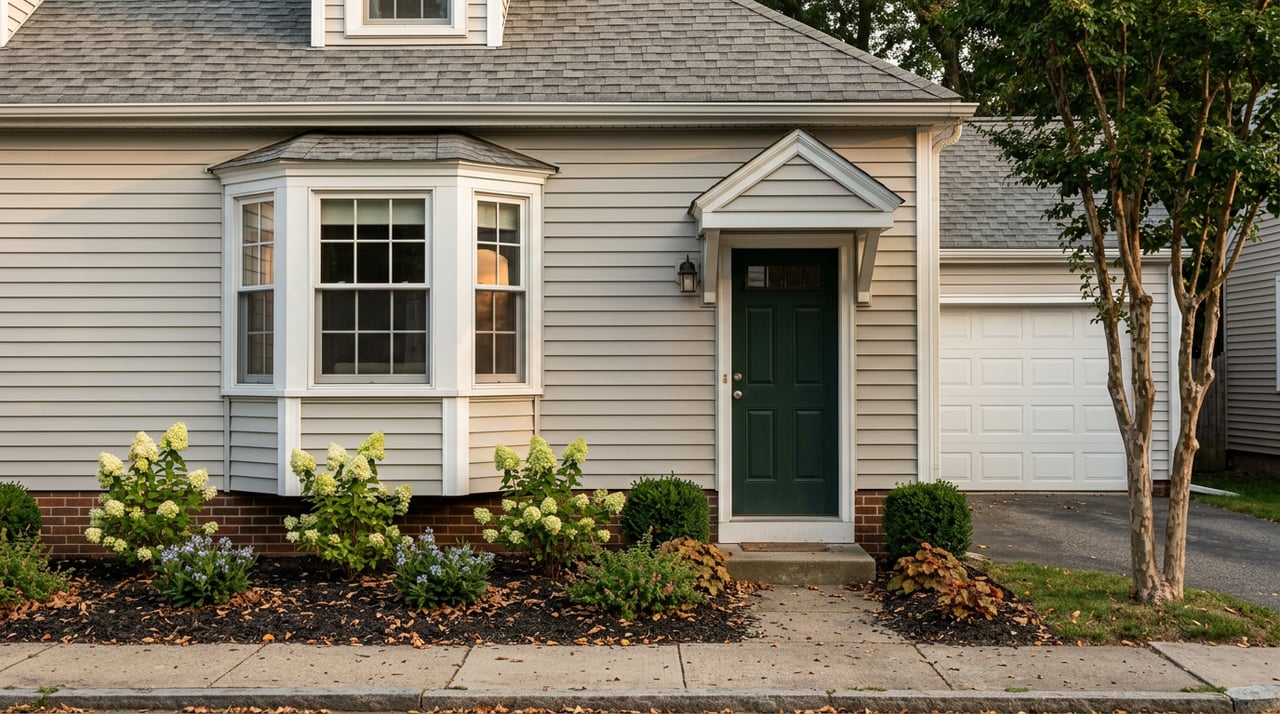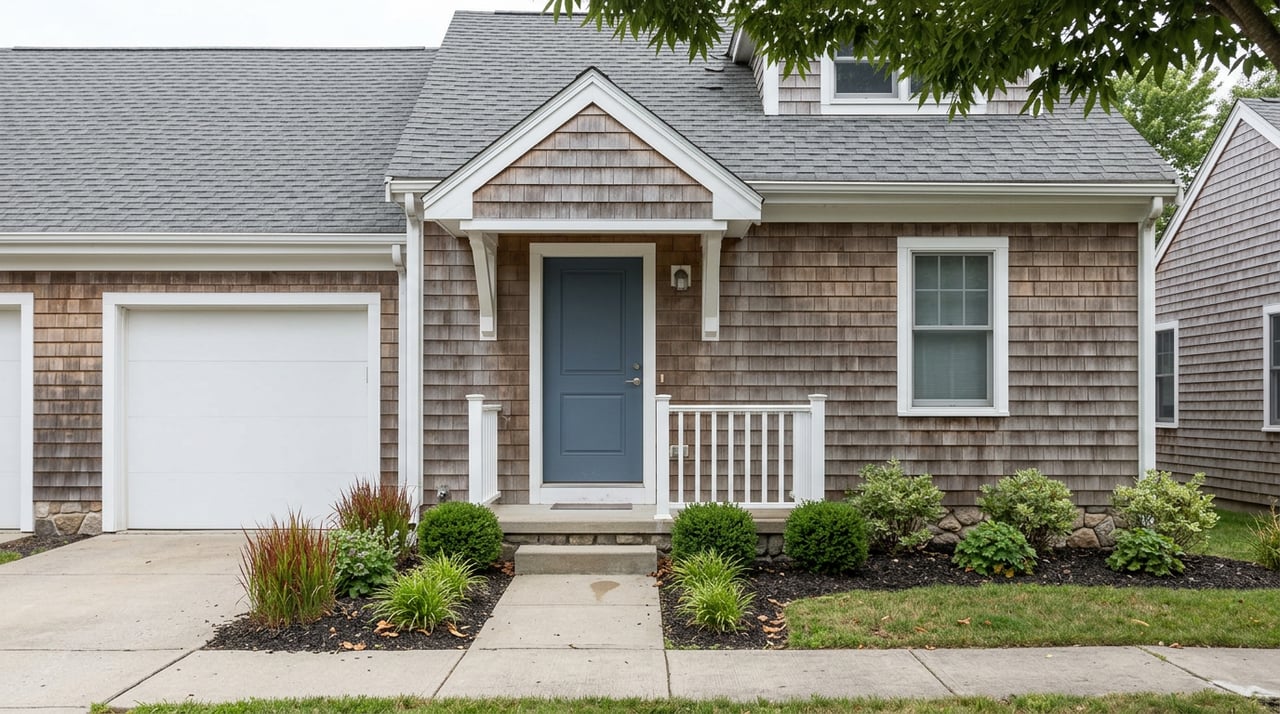
If you have been circling Bedford on your house-hunt map and noticed local headlines about a new "starter home" zoning push, you might be picturing relief. A wave of smaller, more affordable places finally cracking open a market that has priced out a lot of first-time buyers. That is not quite what is happening.
The actual proposal moving through Bedford's approval process right now would build smaller homes. It does not require them to be cheaper.
The Proposal That Skipped the Affordability Requirement
The clearest example sits on a nearly one-acre lot at 49 Elm Street. Developer David Goldbaum has been working with attorney Pam Brown and Lynne Sweet of LDS Consulting Group to bring nine units to the site, eight of them new construction and the ninth a renovation of the existing farmhouse. The location is walkable to John Glenn Middle School, Bedford High School, the library, and the municipal complex, which is exactly the kind of in-town parcel that "missing middle" housing is supposed to fill.
Under Bedford's current zoning, Goldbaum could only build a two-family dwelling with an accessory unit on that lot. He first tried for a comprehensive permit under the state's Local Initiative Program, sometimes called a "friendly 40B," and the Select Board turned it down in August 2025. So the team pivoted to Chapter 40Y, the state's starter-home statute passed back in 2022. Massachusetts only finalized the tools towns need to actually use 40Y this year, with model zoning templates arriving in late spring 2026, which is why Bedford is only now able to act on a law that has been sitting on the books for four years.
Then came a second pivot. Rather than adopt the state's 40Y framework, with its site-plan-approval requirements and state oversight of the zoning, Brown proposed writing a local bylaw instead, giving the town more control over the details. Planning Director Tony Fields said a project like this addresses real "missing housing size" in Bedford, but flagged concerns about how much control a state-run 40Y district would take away from local boards.
Here is the part that matters for anyone budgeting around this news. Under the draft bylaw, there is no affordability requirement. Brown told the Select Board that skipping the 25 percent affordability component was precisely what let the price of each unit come down, since builders were not carrying the cost of subsidized units alongside market-rate ones. Select Board members Dan Brosgol and Terrence Parker both pushed back, saying they would only support the project if the units were genuinely affordable, not simply smaller. Brown's read on the likely buyer: someone middle-income, priced out of Bedford's typical detached single-family stock, but not necessarily priced into an income-restricted unit either.
That is the mechanism worth sitting with. "Starter home" in this context describes square footage and lot density, not a price ceiling.
Bedford Already Has Four of These Quietly Underway
The Elm Street proposal is not an isolated experiment. Bedford has been running several overlay districts for a few years now, and current Planning Board filings show real projects moving through them:
| Location | Overlay district | What's proposed |
|---|---|---|
| 38 & 44 Loomis Street | Multifamily Housing Overlay, Loomis/Depot Center Subdistrict | 14 townhouses across four buildings |
| 10 Webber Avenue | Multifamily Housing Overlay, Loomis/Depot Center Subdistrict | 4 units as two duplexes |
| 1 Railroad Avenue | Depot Area Mixed Use Overlay | 18 apartments plus roughly 4,000 square feet of commercial space |
| 119 Great Road | Horizontal Mixed Use, Great Road/Center district | 2 residential units in the "middle building" |
None of these require affordability set-asides either, as far as the public filings show. What they share is a bet that clustering density around Bedford's Depot Center and Great Road corridor, rather than scattering it across single-family lots, is the path the town is comfortable taking. Bedford's March 2026 Annual Town Meeting warrant carried its own version of the same idea, with a Cottage Overlay District up as Articles 30 and 31, aimed at allowing smaller-footprint homes in more places around town.
Add it up and the pattern is a town trying several zoning tools at once to loosen a genuinely tight supply, while treating affordability as a separate, unresolved question rather than something new zoning automatically solves.
What the Median Actually Buys Right Now
None of this shows up yet in Bedford's headline numbers. As of December 2025, the median sale price in Bedford sat at $973,000, up 13.5 percent year over year, with homes averaging 44 days on market and drawing about three offers each. By July 2026, homes coming onto the market were listed at a median of $1.29 million, a list-price figure rather than a closed-sale one, but still a signal that sellers are testing higher ground.
Boston Magazine's April 2026 profile of the town, which ranked Bedford ninth on its Top Places to Live list, put a finer point on what that median actually spans. Smaller fixer-uppers were selling for under $900,000, while a six-bedroom single-family could run past $2.5 million, with the town-wide average sitting around 48 days on market and prices up close to 10 percent for the year. That is a wide enough range that "Bedford's median" tells you almost nothing about what a specific buyer will find, which is exactly why the new smaller-unit product at Loomis Street, Webber Avenue, and eventually Elm Street matters. It is filling a size category that barely exists in Bedford's current inventory, even if it is not filling a price category most people would call a starter price.
Commuting adds its own asterisk. Bedford is not a one-seat ride to Boston. The MBTA 62 bus connects Bedford's VA hospital area to Alewife Station, a 20-minute Red Line ride from there into Downtown Crossing, and the Fitchburg Line commuter rail stops in neighboring Concord rather than Bedford itself. Driving in typically runs about 30 minutes off-peak, longer during rush hour. None of that shows up in a listing photo, but it shapes who is willing to pay Bedford's prices in the first place.
The Demand Layer Most Buyers Don't Count
Bedford's market has a quieter stabilizer that rarely comes up in a typical home search: Hanscom Air Force Base, sitting right at the town's edge. Hanscom is a non-flying, research-and-acquisition base with a workforce that skews heavily toward contractors and civilian personnel rather than uniformed service members rotating through short tours. Most military families assigned there live off-post in the surrounding towns, and housing allowances are set to reflect the Boston-metro premium rather than a national average.
That means Bedford, along with Lexington, Concord, and Lincoln, carries a layer of steady rental and purchase demand tied to a federal research employer rather than to the broader Boston job market's usual swings. It is not the kind of number that moves a median price on its own, but it helps explain why days-on-market in Bedford has stayed relatively short even as rates and affordability have squeezed buyers elsewhere. The Minuteman Bikeway, which connects Bedford through Lexington to Cambridge, is one more piece of that same infrastructure that keeps the town attractive to commuters who work in the research and tech corridor around Route 128 without needing to drive every day.
What This Means If You're Touring Bedford This Fall
If you are comparing Bedford against Lexington or Concord on price alone, widen the lens. The new unit types coming out of the Loomis Street, Webber Avenue, and eventual Elm Street projects will likely land in the same $900,000 to $1.2 million range as Bedford's existing smaller single-family stock, not meaningfully below it. If your goal is genuinely lower-priced entry into town, a currently listed fixer-upper is still a more realistic target than waiting for new construction under any of these overlays.
If you already own in Bedford and are thinking about selling, the townhouse and small-multifamily product filling in around Depot Center is worth watching as a comparable set, since it is the first meaningful new supply in that size category the town has seen in years. And if you are the kind of buyer weighing rental income alongside a purchase, Hanscom's steady contractor workforce is a demand factor worth factoring into any pro forma for a unit near the base or along the bikeway corridor.
A Few Common Questions
Is the 49 Elm Street project approved yet? As of this year, it was still working through Bedford's local approval process, with the bylaw language being revised for Planning Board and Select Board review ahead of a possible spot on the town's zoning warrant. No units have broken ground.
Will any of these new units include affordable housing? Not automatically. The draft local bylaw for 49 Elm Street explicitly does not include the 25 percent affordability requirement that a state 40Y district would carry, and the existing overlay-district projects at Loomis Street, Webber Avenue, and Railroad Avenue do not appear to carry one either based on current filings.
Does more supply mean Bedford's prices will come down? Not on the timeline most buyers care about. These projects add a few dozen units at most across several years, in a town where December 2025's median sale price was already $973,000. It is a supply story worth tracking, not a near-term price correction.
If you are trying to figure out where your budget actually lands in a town moving this many pieces at once, that is exactly the kind of question a local conversation answers faster than a listing search. JMR Real Estate Group knows these zoning districts, these streets, and these numbers because we work them every week. Get a free home valuation and let's talk about what Bedford's next few years actually mean for your move.